

In Part 1 and Part 2 in this series, I explained how market, technology, and infrastructure changes over the past several years have encouraged me to buy an EV. In this third entry, I address overall value proposition, including availability of federal incentives, and walk through my evaluation of EV models.
When I decided in November that I was ready to buy an electric vehicle, I already had a few models on my radar. Between 2021 and today, only Ford’s Mustang Mach-E remained on my list, largely owing to Ford’s continuing efforts to deliver more efficient and lower-cost variants. We learned just this month that those efforts had produced the Mach-E’s first 50,000+ delivery year in 2024. On the plug-in hybrid (PHEV) side, my positive experience with 4Runner ownership had me fixated on Toyota’s RAV4 Prime.*
*Toyota recently rebranded it as the RAV4 Plug-in Hybrid for the 2025 model year.
But General Motors had several new models on the market winning plaudits for good all-around value, Hyundai’s IONIQ 5 was drawing rave reviews for its superior technology, and my indecision around fully committing to a full battery electric vehicle (BEV) kept a couple other PHEVs in the running.
Thanks to some advice from friends in the industry, I widened my search a bit. In all, I ended up looking at roughly a dozen EV models, including several PHEVs. Before I get into my process of elimination, I need to cover one market-level consideration I haven’t addressed in prior posts: policy and effects on pricing.
Federal policy and pricing
Federal policy has been catalytic for EV sales over the past 15 years, with IRS tax credits of up to $7500 closing the gap in upfront purchase cost between gas vehicles and EVs. Though I’m writing this post in my personal (not professional) capacity, I won’t opine on the politics of the Inflation Reduction Act’s tax credits for EV purchases.
That said, as a car-buyer, one must both consider the available incentives and future policy risks that could impact EV purchase costs in 2025 and beyond. The prospect of impending tariffs could impact all vehicles, and effects on specific OEMs or models are unknown at this point. Those could conceivably bite vehicle purchase costs early in the year, but more likely would show up later in 2025 as they ripple through supply chains.
Federal tax credits
There are three relevant tax credits:
- 30D, which provides a point-of-sale credit up to $7500 for qualified EV purchases. The IRS publishes a list of qualified vehicles, with cost, final assembly location, and battery content requirements determining eligibility.
- 45W, which provides commercial fleets a $7500 tax credit on light vehicles. OEMs can lease vehicles to consumers to claim that credit for themselves. This allows them to discount their leases.
- 25E, which provides a point-of-sale credit of up to $4000 for a pre-owned vehicle, provided a maximum sale price of $25,000 and that VIN has not previously claimed a 25E credit.
Household income limits also apply to 30D and 25E. I was not eligible for 25E, but likely would be for 30D. Only 45W has no restrictions on household income, vehicle retail pricing, or supply chain considerations. I wanted to ensure I would either get the full $7500 credit or receive a comparable OEM incentive, if I financed a purchase. Hyundai was among those offering this compensatory incentive before its vehicles qualified.

All three credits could be subject to elimination or modification this year. My gut says the status quo prevails through the 2025 tax year, but after that anyone’s guess is as good as mine. Bottom line, I was largely unconcerned about 2025 purchase timing for tax credit eligibility, but felt some urgency to purchase earlier in the year out of concern about tariffs.
State and local incentives
Georgia eliminated its $5000 tax credit in 2015, and there has been no serious effort to revive it. Obviously, buyers elsewhere may have access to state tax credits or rebates, which could impact their own budgetary limitations. Electrek recently put together this comprehensive guide of both EV and charger incentives in each state.
Narrowing down my list
I’ve established that I wanted at least 300 miles of nameplate range, and the various federal tax credits heavily factored into which models I would consider. So here are the vehicles that made my list as my search heated up in November/December:
Top contenders:
- Ford: Escape PHEV
- GM: Chevy Equinox EV
- Hyundai: IONIQ 5, Tuscon PHEV
- Toyota: RAV4 Plug-in Hybrid
Serious looks:
- Ford: Mustang Mach-E
- GM: Chevy Blazer EV
- Honda: Prologue
Also-rans:
- BMW: i3 (used)
- GM: Cadillac LYRIQ
- Kia: EV6, Sportage PHEV
- Volkswagen: ID.4
The others I eliminated for a variety of brand or model-specific reasons. I’m not going to knock any OEMs here, but just because I didn’t consider others doesn’t mean you shouldn’t.
I also won’t dwell on the “also-rans,” which I felt were close to what I might want, but fell short on price (LYRIQ) or range (i3), or in the case of the ID.4, quality concerns that only recently appear fixed. I also eliminated Kia due to its vehicles’ similarity with Hyundai’s comparable models, and my stronger brand perception of the latter. I didn’t bother looking at dealership options for any of these.

The second cut
As I noted previously, I had been eyeing the Mach-E for several years and generally think highly of it. Friends who own them love theirs. It fell short on two measures. First, it wasn’t eligible for the 30D tax credit and Ford isn’t offering sufficiently steep discounts to compensate. Second, it isn’t a platform vehicle (i.e., it’s a one-off in product development) and I’m concerned about longer-term support from Ford as it builds out a broader EV platform for its next-generation vehicles akin to Tesla, GM, and Hyundai/Kia. A lease addresses both shortcomings, but as I was narrowing my selections I still wanted the option of buying.
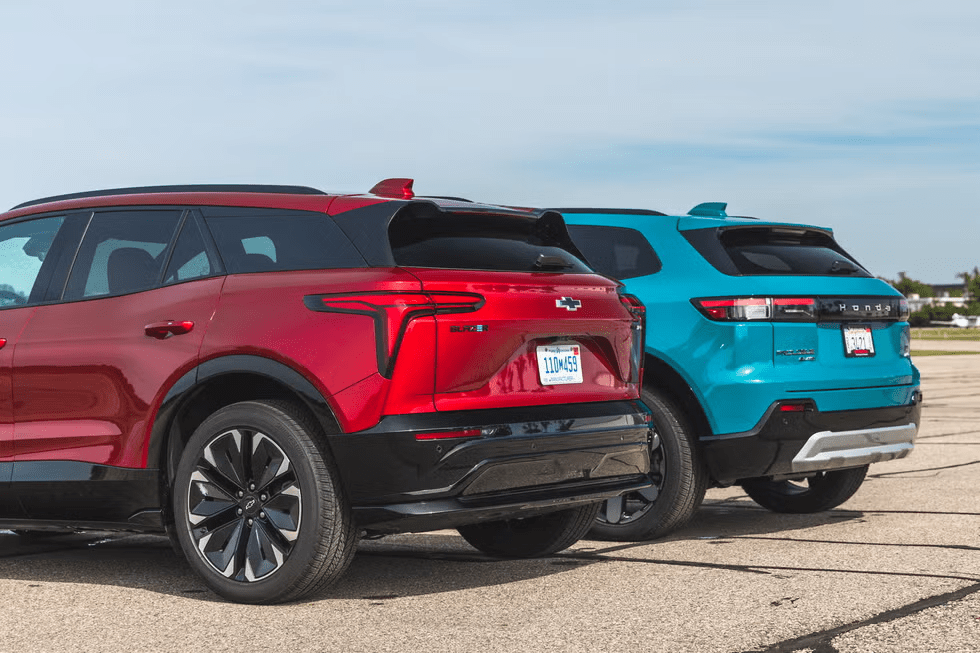
Despite a decorated launch, the Chevy Blazer EV immediately ran into problems when deliveries began in late 2023. By Q2, its reputation (and sales) started to recover, averaging a respectable 2500+ units sold monthly from April through December. I only eliminated it because I preferred the slightly smaller and more affordable Equinox EV of GM’s offerings. That said, the dealer incentives I saw on the 2024 Blazer were steep. Combined with the 30D tax credit, I still see effective discounting up to $16,000.
The Honda Prologue is basically a rebadged Blazer EV developed off GM’s Ultium platform and assembled at GM’s Mexico factory. It was also the best-selling non-Tesla EV in the US in Q4 2024. While I preferred the interior to the Equinox EV, especially the center console and its physical buttons, its higher price tag and lack of OEM or dealer incentives beyond the federal tax credit pushed it off my radar.
The final downselect
Of the final five models, only two were BEVs. Through at least the middle of December, I was still leaning toward a PHEV out of concern for my annual long-distance drive discussed in Part 1. That changed as I looked into the PHEV models, and convinced myself I could manage around my edge case.
In fact, going into this EV search, I expected I would go with the RAV4 Prime. Unfortunately, Toyota doesn’t make many of them, and the ones they do…sell well. So their deals are comparatively poor, which compounds with their lack of tax credit eligibility. Get ready to finance $50,000, or shell out for a similarly expensive lease.
Given the Hyundai Tucson and Ford Escape PHEVs similarly failed to qualify for the 30D tax credit, I decided I’d only lease if opting for either. I discussed PHEVs in Part 2 of this series, and generally found myself uninspired by the options in today’s market. I considered visiting a dealership to look at an Escape, but ultimately relegated it to a fallback option if I couldn’t get comfortable with either of the BEVs.
I also found that, in exploring dealership websites, PHEV inventory was limited and incentives were not great. I kept the Tucson alternative in play, as I already intended to visit a Hyundai dealership for a look at the IONIQ 5.
But barring a change of heart, I was effectively down to that Hyundai IONIQ 5 and the Chevy Equinox EV.
At the dealership
Those who know the EV landscape will notice none of the vehicle models I’ve named are from “direct sales” manufacturers. Which means I accepted right out of the gate that any vehicle would (unfortunately) need to be purchased through a dealership. I’ll note that Hyundai is now selling vehicles through Amazon, but I didn’t bother exploring that option given its novelty and…well…I just wasn’t thinking about it.
I visited both a Hyundai and a Chevy dealership from the same group on Chamblee, Georgia’s famed “Motor Mile.” It was December 21, and I still was contemplating a purchase that day before heading to my parents’ home in Texas for the remainder of 2024.
The experiences were noticeably different.
Hyundai
I chatted with the salesman as he looked for an IONIQ 5 for me to test drive. He’d been selling cars since the 1990s, with most of the past 20 years between multiple Hyundai dealerships. I would’ve guessed he was in his late 50s, and it was clear that he wasn’t a fan of plug-in vehicles. He was a Santa Fe Hybrid owner, and expressed general concern about EV range for his needs, as well as general technology maturity.
But while he didn’t know the Georgia “Metaplant” had already been rolling vehicles off production lines since October**, he acknowledged his dealership’s strong IONIQ 5 sales and appeared generally knowledgable about its key technology features. He knew the 800V architecture and higher DC fast-charging speeds were key differentiators, and talked up the 2025 model year’s NACS integration.
**This has been a strong selling point for Hyundai among many Georgians, including myself. It’s something I’d expect a good salesman in the state to track closely.
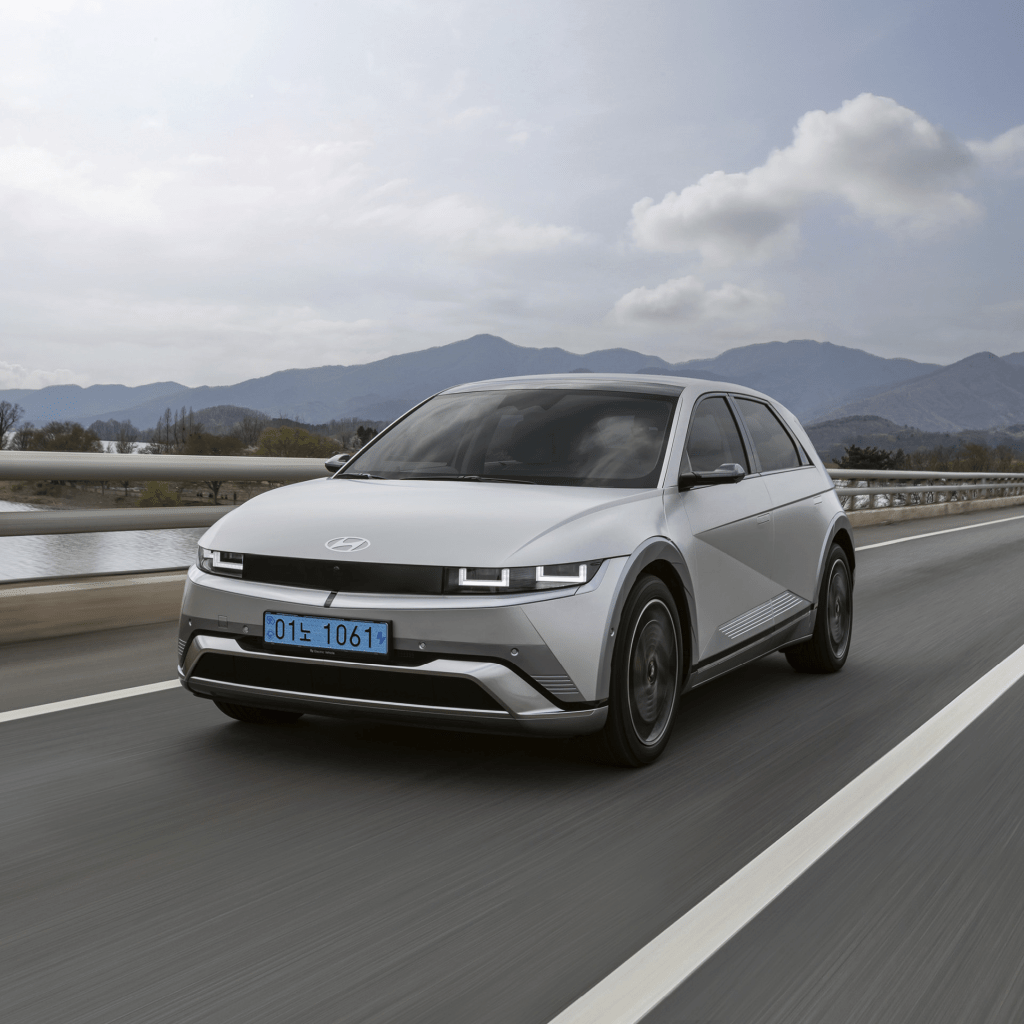
On the test drive, I found the ride quality excellent and the driver assistance systems impressive. In particular, I liked the feature that allows remote-controlled parking. My 4Runner has suffered a few nicks and scrapes over the years from the concrete columns in my building’s garage, and unfortunately none of these EV SUVs are really any narrower. Though as I mentioned in Part 2, I wasn’t placing a high priority on driver assistance features.
While I hadn’t written off a lease on the 2024, I told him to send me a note when he knew when the 2025 model year was shipping. I was disappointed when he said he didn’t have a Tucson PHEV on premises. And then I saw one literally just pulling out for a test drive as I walked out the door to leave. But he knew I wasn’t buying that day, so maybe he was just done entertaining me. Oh well.
Chevrolet
The Chevy salesman I spoke with was younger, probably in his mid 30s. He also split time between the group’s Chevy dealership, and both the neighboring Cadillac and GMC shops. I never asked him what he drove, but he was certainly savvier about GM’s complete EV lineup. If you’ve seen the sales figures, you won’t be shocked to learn he was high on the Chevy and Cadillac offerings, and less so on GMC’s.
He said about half their Equinox and Blazer EVs were currently sold to employees on generous 24-month lease deals available through their employee discount program. As I understand it, GM isn’t the first OEM to push EVs into the hands of its salespeople (e.g., Nissan did it with the Leaf). It’s a smart strategy to build both knowledgeability and enthusiasm among the people ultimately responsible for educating consumers.
The salesman explained Chevy’s tiering of trims for the 2024 model year, which I had yet to research. And honestly, it confused the hell out of me. LT1, LT2, LT3, RS2, RS3. GM fortunately recognized it needed to streamline its options, and the 2025 model year will only have LT, RS, and more rugged ACTIV package. I was less concerned with the exact package since the features I actually care about – 800V architecture and NACS integration – would not be features in any of the 2024 or 2025 models.

The test drive of the Equinox was good, albeit a bit less impressive than my experience with the IONIQ. It felt like the more comfortable ride, trading out a bit of dynamism. That’s a consistent observation in their reviews. I didn’t pay attention to the driver assistance features, seeing as they differ across trims and I wasn’t insistent on any in particular.
The aftermath
I decided about halfway through my visit to the Hyundai dealership that I would not buy my vehicle that day, and would instead wait until I returned to Atlanta in 2025. I left both dealerships reasonably confident neither OEM (nor their respective dealerships) would be pulling incentives in January, and the only risks of waiting were the Equinox EV potentially losing its tax credit eligibility or the 2024 models of both vehicles flying off lots before year-end.
I initially wanted to see whether the 2025 IONIQ 5 would ship early in January, but was still considering a lease for the 2024 model year. Either way, the IONIQ felt like the more impressive car, with more advanced technology integration. Its more compact frame was attractive, and more in line with the downsizing I wanted from my 4Runner. One downside: as with several other models (like the Mach-E), the IONIQ comes in both standard (245 miles) and extended (318 miles) range options. That complicated deal hunting, with my options effectively limited to the more expensive packages.
The Equinox was by no means unimpressive, just a bit less flashy. Including incentives, it was more affordably priced with its entry models. Deal-hunters also sacrifice selectivity on vehicle trim, so it wasn’t clear what features I’d actually be getting if I opted for a 2024 model. But even the base Equinox models exceed 300 miles of nameplate range, so I determined the trim would be irrelevant.
On January 1, the IRS published its new list of qualified vehicles and not only had the Equinox EV maintained its eligibility, the IONIQ 5 had joined it. (UPDATE: It appears Hyundai’s inclusion by IRS was in error and it will not receive eligibility until at least Q2.)
On January 3, after an evening playing around with pricing online, I made my decision.
 Nathaniel Horadam
2 thoughts on “I finally decided to buy an electric car. Here’s what it means for EVs in America (Part 3)”