
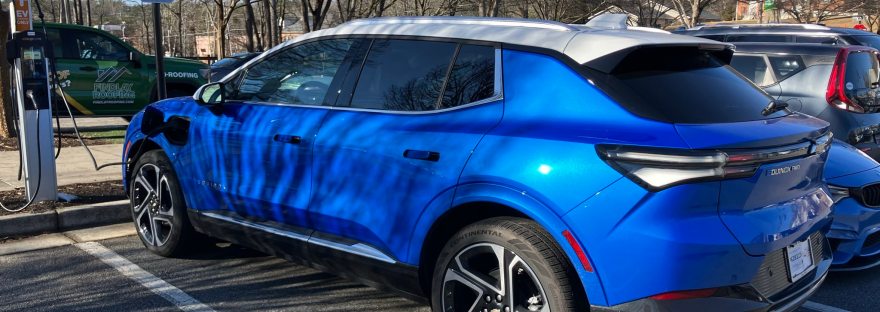
I’m not going to bury the lede…I bought a 2024 Chevy Equinox EV.

Leased it, to be precise.
It won out over the other finalist, Hyundai’s IONIQ 5. In this final entry in my series on buying my first EV, I’ll explain why I landed on the Equinox and why I decided to lease instead of financing it. And then I’ll share a few first impressions and final thoughts on the EV market at the start of 2025.
If you missed my prior entries and want to understand how I got here…
- Part 1 on how I finally got comfortable with buying an EV for the first time.
- Part 2 on my vehicle technology and infrastructure considerations.
- Part 3 on federal policy and my down-selection process.
Equinox vs. Ioniq
Several factors ultimately landed me on the Equinox. Even though I felt the IONIQ had a stronger technology package, and was probably the superior all-around vehicle, the Equinox simply offered better value.
I’d spent a few weeks looking at dealership inventory online, evaluating pricing through configuration of finance/lease options with various discounts included. Hyundai has been aggressive with manufacturer discounts to compensate for lack of 30D tax credit eligibility, but I saw less in terms of dealership incentives. It’s possible that’s because 2024 IONIQ inventory has been clearing quickly without the need for extra discounting, or alternatively the push from Hyundai on its dealers wasn’t strong.
Either way, the dealership incentives for the Equinox were steeper, on top of tax credit eligibility. I wasn’t as concerned with specific trims, though still-solid 2024 model year availability would leave me more flexibility with the dealership. Even looking online today across multiple dealerships in the Atlanta area, I see plenty of 2024 Equinox (and Blazer) EV models available with steep discounts at Chevy dealerships, while Hyundai’s have far less 2024 inventory.
The cherry on top? The Equinox’s blue-and-white color scheme. Car-buying is rarely purely rational. Image matters, and I’m a sucker for that styling.
Pulling the trigger
I walked into the Chevy dealership on January 4 expecting to finance the vehicle on a 60-month term, but the lease terms on offer were just too good to pass up.
I’d checked the dealership’s online inventory the night before and found not only was a blue-and-white vehicle available, but after the new year they had increased their dealer incentive from $4000 to $6000 on all 2024 Equinox EVs. Throw in a $1500 “conquest bonus” for switching from a non-GM model, and I was already looking at $7500 in incentives before the tax credit. Playing around with my 4Runner’s trade-in value got me to an ideal monthly payment.
The next morning, the salesman confirmed they had the model I wanted in stock. I’ve noted I didn’t particularly care about the trim, but this one ended up being a 3LT AWD, the second tier. After looking at the financing vs. lease options, I realized I’d be foolish not to lease.
- The timing would put my lease expiration at December 2026, at which point I could reasonably expect greater market optionality, possibly at lower cost.
- The technology features I discussed in Part 2 of this series (NACS charging integration, 800V architecture) will almost certainly be standard EV features by late 2026.
- In the event of major lifestyle changes, or just the BEV simply not working out for me, I could revert to a PHEV at that point (when better options would be available).
- The deal was just really, really good.
Your mileage may vary (e.g., trade-in value, credit score, cash-down appetite), but I ended up locking in a $4000 down (trade-in equity), $178/month 24-month lease. If I hadn’t been in a hurry to catch a flight, I likely could have negotiated that down further.
I’ve seen better lease deals advertised by other OEMs since, but have also heard from friends inquiring that those deals are hard to find in practice.
First impressions
My first long drive in the new Equinox was about 70 miles roundtrip last Sunday. I drove from Midtown Atlanta to Woodstock for lunch and coffee, and then to Alpharetta’s Avalon shopping center before returning home.

Driving
The drive quality was frankly better than I expected. The handling is excellent and even without top-of-line performance specs, the acceleration makes for a more enjoyable drive than my old 4Runner. I haven’t had enough exposure to the driver assistance features to develop any real opinion yet, but I did find the Equinox has one-pedal drive, which I didn’t catch in my test drive.
While the console has fewer buttons and dials than ideal, I appreciate the physical dials for temperature and volume control. I don’t feel overly distracted managing the vehicle’s controls through that infotainment console. Given I just jumped 10 model years, I feel my experience with this vehicle will be something of an acclimation to a lot of modern tech.
Charging
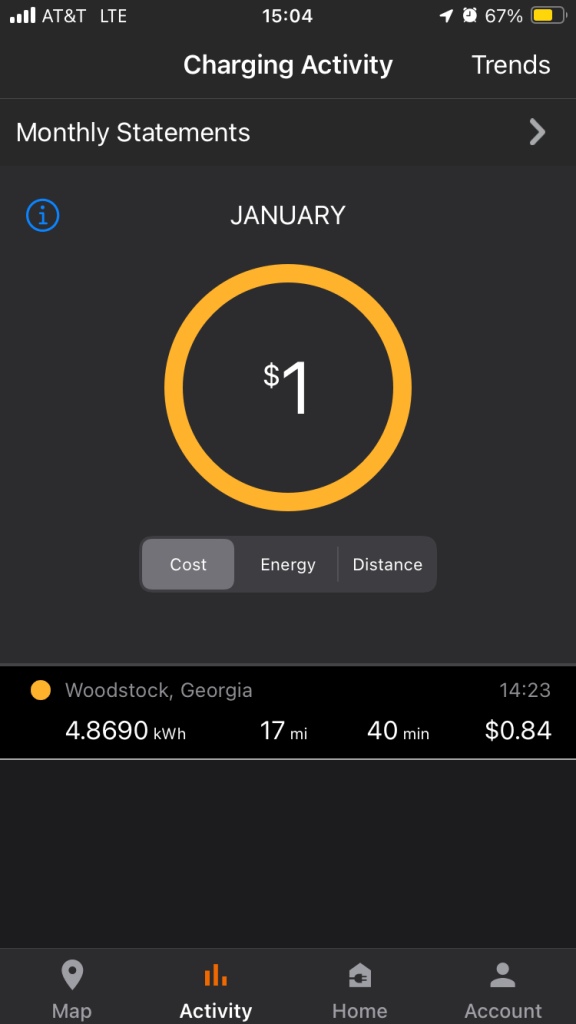
I’ve plugged into one public charger thus far, a ChargePoint level 2 port in Woodstock, GA’s city center. It worked perfectly…and allowed me access to an otherwise-full parking lot for $.85 worth of charge time. So far so good.
At home, the charging experience has been great as well, one my building manager turned my unit on from the switchgear. It turns out I was wrong in Part 1 about my charger’s rating…it’s not a level 1, but rather a low-power level 2 charger that reaches about 3.5 kW output. That’s roughly twice what I expected. Still won’t take me from 20%-80% in a standard overnight charge session, but good enough for 100+ miles in that time.
Software
I hadn’t really thought about mobile apps or infotainment software throughout my EV search, but I’ve been pleasantly surprised to date. I appreciate the trip planning features integrated into the Google Maps-based navigation system, especially the state-of-charge forecast at arrival. Chevy has API integrations with several major charging networks, including ChargePoint, EVgo, EvGateway, and Blink, and thus far I’ve found real-time charger availability on both the app and the in-cabin Google Maps app to be excellent.

The app is a bit buggy, and I haven’t determined yet whether the inconsistent functioning of remote controls (i.e., vehicle start, lock/unlock) and charge management are a general software issue or specifically a signal issue owing to my building’s garage. Hopefully it will improve over time, but overall, I still have low expectations.
Final Thoughts
I started writing this series because I hoped it would help others grappling with their own EV purchase decisions. Even as someone who works in the industry, I found the market a bit overwhelming for a first-time buyer. Here’s are some closing thoughts and observations:
- It’s impractical to seriously evaluate more than a few models given the variety available at both the mid-market and premium price tiers. We’re also now at a point where nearly every mass-market OEM has a viable BEV model. You’ll naturally gravitate toward a couple of them, and then just benchmark against the Hyundai or Tesla models to round out your search.
- If you plan to lease right now, there’s very little downside to targeting the clearance model year. This is obviously a value play even with ICE vehicles, but given EV technology changes expected over the next couple of years and current EV residual values, it’s likely the best approach for most first-time EV buyers.
- If you want to buy and roadtrip charging is important, it may be best to look for models with NACS compatibility out of the gate. Those will start hitting the market this year.
- Unless you expect to put a lot of mileage on your vehicle, you may not end up saving much money in switching from an ICE vehicle. Buying a BEV obviously carries an environmental benefit (yes, no matter how “dirty” the grid electricity where you live), but it’s also an all-around superior experience.
- The PHEV options today are genuinely lackluster and probably won’t save you money over a conventional gas-hybrid (HEV) unless you drive a lot. They’re still a fine option if you’re motivated to go with a plug-in and can’t quite get comfortable with a BEV. Upcoming models (especially “EREVs”) will change that, but won’t start showing up until at least 2026.
- There will be plenty of noise in 2025 about federal policy, particularly the future of the tax credits. I doubt you’ll see those pricing effects this year, but 2026 is an open question.
Hopefully some folks have found my sharing this narrative relevant and helpful. Best of luck on your own search and purchase!
 Nathaniel Horadam
1 thought on “I finally decided to buy an electric car. Here’s what it means for EVs in America (Part 4)”