

If you’ve read my previous posts detailing my EV purchasing decision, you may recall I don’t drive much on a day-to-day basis. But I love roadtrips, and at minimum I needed to feel comfortable covering a lot of ground in an EV across Georgia and the Southeast before buying one.
So like many other prospective EV buyers, my access to reliable fast-charging across our highway network was an important purchase timing consideration. The AWD trim on the Chevy Equinox EV I ended up leasing had a nameplate range of 285 miles*, and that in theory should have me covered for most journeys to major cities within 4 hours.
*While not a major issue ultimately, I wasn’t aware of the nameplate range reduction on the AWD trim. I’d been under the impression I was getting the 2024 model year’s standard 305 kWh.
Over the past several months, I’ve finally completed my first road trips in the Equinox. The first was an overnight trip over Memorial Day Weekend to Birmingham for the SEC baseball tournament in Hoover (Go Commodores!). Then in mid-June, I took a daytrip to Chattanooga for a hike and more on Lookout Mountain. Finally, a few weekends ago, I drove to Augusta for lunch with a friend.
I’ve learned quite a bit about how my vehicle’s specs translate in the real world, EV infrastructure in the Southeast, and where state and local policymakers can lean in to accelerate EV adoption.
- The good:
- DC fast charging infrastructure has exploded in my region.
- The Chevy in-vehicle navigation does a great job of identifying available stations and their charging speeds.
- Even where mobile apps failed me, tap-and-pay ensured I never suffered any misfires
- The bad:
- Charging stations aren’t advertised from the highway like gas pumps. Unless your mobile app or console navigation points shows you their locations, you would have no idea they’re there.
- Overnight charging as a tourist in Birmingham was basically non-existent.
- The messy:
- It’s easy to forget Atlanta is on the edge of Appalachia, and trips north and west involve covering a lot of hilly terrain. Throw in…uh…higher speeds and effective range was closer to 250 miles.
- Without access to the Tesla Supercharger network, there are still a few areas that feel like charging deserts, even if technically options exist
Since roadtripping is such an integral feature of leisure travel in the Southeast, the general perception of fast charger availability will play an outsized role in EV adoption for the foreseeable future. State policymakers and charging station operators should be doing more to promote awareness of increasing availability.
The public charging boom
As industry analysts and reporters have noted in the past couple of months, public EV charging has markedly and noticeably improved since all that bad press of the early 2020s. Both in terms of reliability (see: here) and coverage (see: here, here, and here). Okay, one more. I highly recommend reading this EV travelogue from the Wall Street Journal’s Christopher Mims. The positive press is undoubtedly good news, but your mileage may vary (literally) depending on where you live. I’ve found that, from Atlanta, the problem is indeed getting solved rapidly.
Just take a look at these DC fast charger coverage maps of the Southeast from a handful of non-Tesla charging networks as of early August.

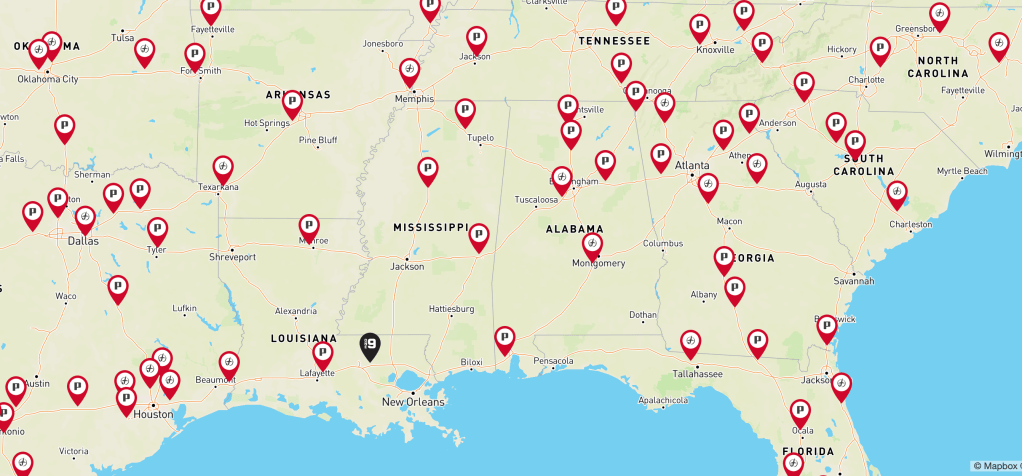


These maps are only a snapshot of the race, much of it now pushed by the OEMs themselves, to address perceptions of highway fast-charging gaps across the country. I only included Electrify America, Pilot/Flying J (EVgo under GM Energy), Mercedes-Benz, IONNA, and Rivian. I didn’t include the broader EVgo coverage map, or ChargePoint, Blink, EV Connect, and others that have been filling these gaps over the past few years.
Finding DC fast chargers (and paying for them)
I’ve noticed my Chevy app’s trip planning feature and in-vehicle navigation have done a great job of identifying these chargers, with API integration showing availability, charge speed, and in some cases, even pricing.
That said, I think pro-EV policymakers would be well-served thinking about how they can increase awareness these chargers exist for non-EV drivers. You’d have no idea from the highway unless you were either looking for them (the Tesla and Mercedes chargers at Buc-ee’s are easily spottable from the road) or had your vehicle’s navigation system identifying them. Better media coverage might bridge the information gap, but a little roadside signage would go a long way to plant the idea in the minds of passing motorists.
I’ve also noticed my Chevy app has started recently offering payment integration with various charging networks, hoping to solve for the half-dozen network apps I’ve had to download over the past few months. In some cases, I struggled to initiate a session with the network’s app and had to use tap payment with a credit card. But I’ve never been completely unable to initiate a charging session…so that’s a plus.
There were only two episodes in my trips where I felt some degree of anxiety or frustration:
The first was my afternoon in Birmingham after the first baseball game, where I was hoping to find a good Level 2 charger and leave my car for awhile. Easier said than done. Aside from a Tesla Supercharger station Downtown, there were only a handful of suboptimal options. I first tried a ChargePoint Level 2 dual-port unit rated for 20 kW in the Birmingham News parking lot, across from the Amtrak station. It topped out at less than half that rate, and was charging me almost $.70/kWh, so I cut that session short after 8 kWh.
I ultimately found a Blink DC fast charger at a Stellantis dealership that took care of my full charging need in the 40 minutes it took me to walk a mile to grab coffee and back. I suspect Blink had some trouble metering the session though, because my credit card statement later showed a mere $10.00 flat charge. Based on the advertised rate, it should have been about double that.
The second was my return trip to Atlanta from Augusta, since there’s a long stretch on I-20 between the outskirts of both metros that is effectively a DC fast charging desert. I ended up stopping at a Rivian Adventure Network station at a shopping center in Augusta, with enough time to pick up a case of Topo Chico and use the restroom before hitting the road again. It was the only good non-Tesla option (I never bothered to get a NACS adapter) on my way back, but if the station hadn’t worked I would’ve had to go more out of my way to find another.
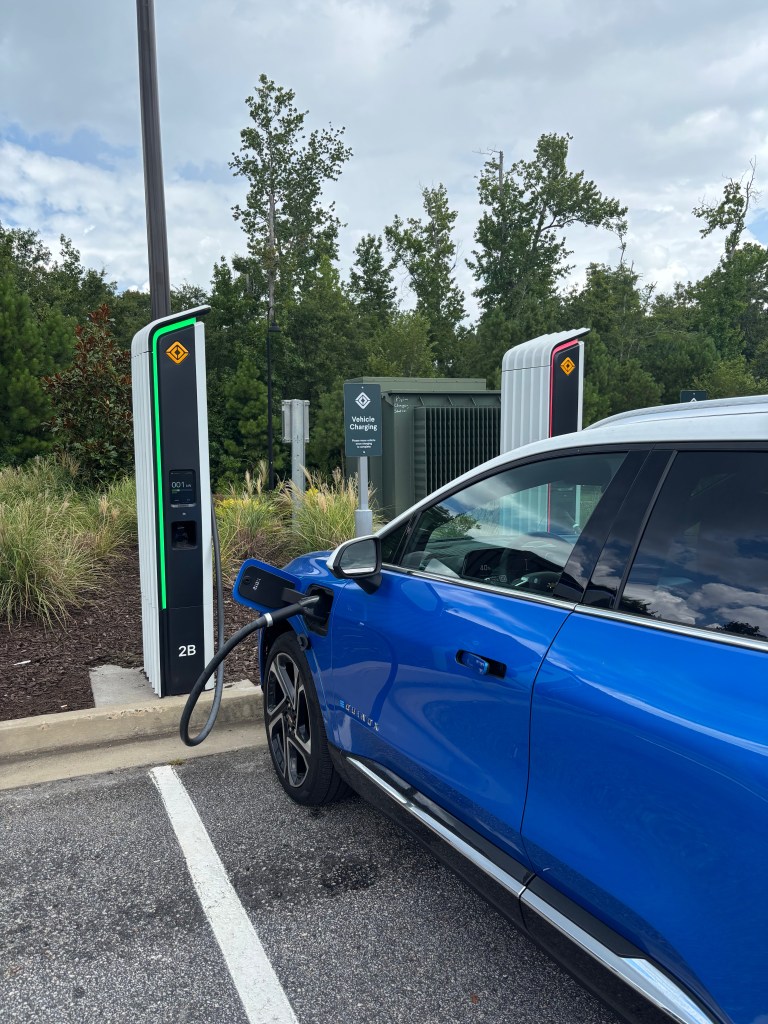
Southeastern cities like Birmingham, Greenville, Huntsville, Memphis, Chattanooga, and Columbia tend to have a surplus of surface lots left over from their urban renewal “raze everything so suburban commuters can drive in and park cheaply” heydays. They’d be well-served by installing large Level 2 depots with overnight parking. Hotels tend to be clustered in the same general area, so it’d be relatively easy to site a central facility for general purpose tourist charging.
Battery performance and lessons learned
While none of my journeys was particularly challenging, I knew I’d likely need to charge at least once on each to make it home. Trip 1 covered roughly 175 miles from my home to Hoover’s baseball stadium, before ending in downtown Birmingham.
I left with a full battery. I’ve gotten in the habit of charging to 100% SOC when at home because, after all, I’m only leasing this Equinox for two years, don’t need to charge very often, and my 3.5 kW L2 charger won’t degrade the battery much anyways.
Home charging has been going great, by the way.
I arrived at my hotel with about 35% SOC, and then went on the aforementioned charging expedition to get myself enough juice to cover the return trip. I had enough juice to make it back to the stadium the following day to watch Vanderbilt win the SEC championship, and then home with about 10% SOC remaining. Even though it took me almost 30 hours to recharge at home after that, I was safely above 40% by the following morning and that was more than sufficient for any routine errands.

Trip 2 covered about 120 miles from my home to a friend’s house on Lookout Mountain, where we grabbed lunch, went for a long hike, and then did dinner at the base of the mountain. My return trip was almost a retrace of the inbound route. I left for Chattanooga with 95% SOC, and reached my friend’s place with about 45%. So I knew I’d need a brief charge on the way back.
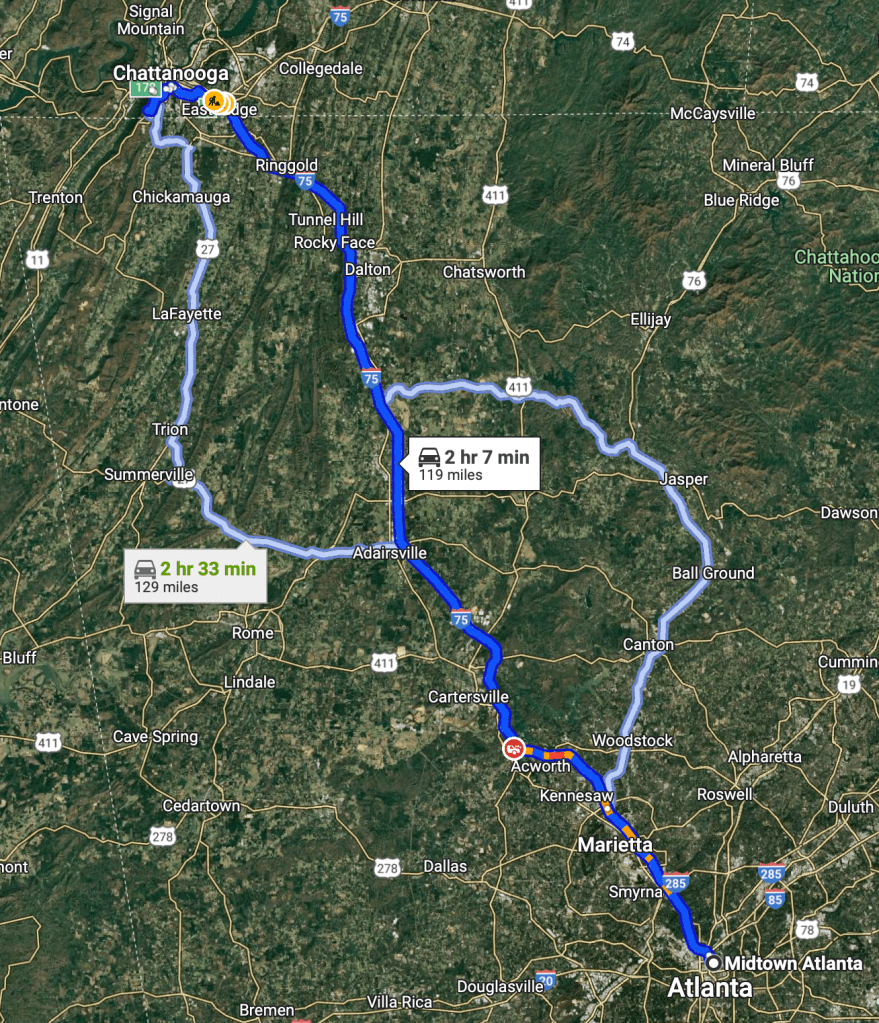
I found a GM Energy (EVgo) station at a Pilot/Flying J just north of Calhoun, GA and picked up an extra 13 kWh in 5 minutes of charging to reach 40% SOC. I made it home with about 15% remaining.
Finally, the Augusta trip was a pretty flat ~145 miles each way. I did take a detour for coffee and a pastry in downtown Covington on the way back, but that probably only added five or six miles. I charged for 15 minutes and added 30 kWh at that Rivian station, which, as with the other trips, got me home with something around 10% SOC.
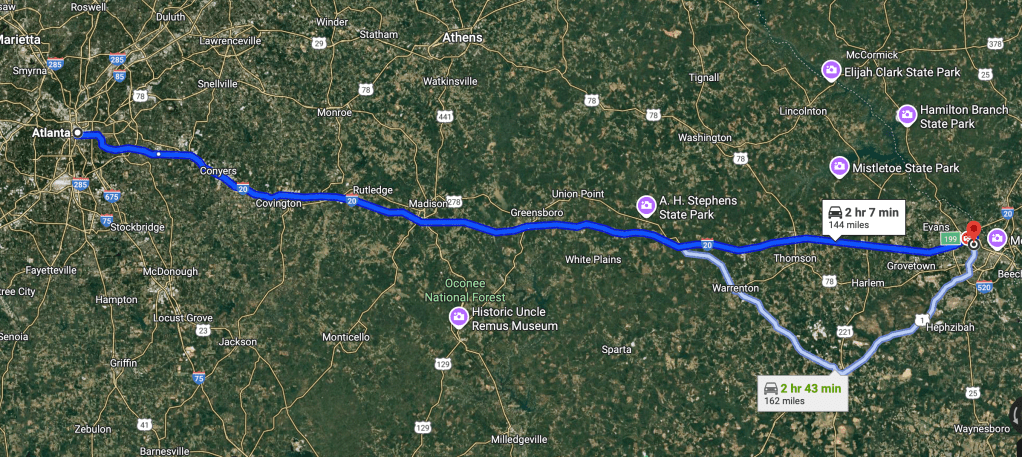
My range on these trips was closer to 250 miles than the 285-mile battery nameplate. Even less on the Chattanooga trip, which involved a good amount of elevation gain in that region. The terrain going north and east from Atlanta complicates range estimates, and certainly driving close to 80 mph most of the way doesn’t help.
The main lesson I’ve taken from these experiences is I probably can’t make it to Nashville, Charlotte, or Savannah on a single charge, despite all three being roughly 250 miles away. And that’s fine, considering I’d probably want a single bathroom and/or coffee break in between. I also found I was fairly effective in extending my range with more focused and conservative driving (i.e., less aggressive acceleration) and didn’t have reason for concern if my return trip range estimates final SOC at around 10%.
As a final note, I’ve realized that it’s not too soon to start thinking about my next vehicle. I might want a bit more range — closer to that 300-mile magic number — but it probably doesn’t need to be much higher given how much the charging situation has improved.
The vehicle options haven’t changed much since I pulled the trigger on my 2024 Equinox EV in January, though the product roadmap leading into late 2026 is coming into focus. I might provide another update in early next year when those options crystalize.
In any case, I won’t be concerned with the charging network, Tesla or otherwise.
 Nathaniel Horadam
2 thoughts on “I’ve now seen it with my own eyes, EV charging is rapidly improving in the Southeast”